Chromite
Primary ore of chromium, essential for stainless steel production.
Chromite is a mineral from the spinel group, made up mostly of iron(II) oxide and chromium(III) oxide, with the formula FeCr2O4. Magnesium can replace iron in varying amounts, forming a solid solution with magnesiochromite (MgCr2O4). Aluminium can also substitute for chromium, producing hercynite (FeAl2O4). Today, chromite is mainly mined to create stainless steel, via the production of ferrochrome (FeCr), an iron-chromium alloy.
Chromite grains are typically found in large mafic igneous intrusions, such as the Bushveld in South Africa and deposits in India. The mineral is iron-black, has a metallic luster, a dark brown streak, and a Mohs hardness of 5.5.
**Properties** Chromite occurs mostly in mafic-ultramafic igneous intrusions and sometimes in metamorphic rocks. It forms layered deposits that can stretch hundreds of kilometers long but are only a few meters thick. Chromite is also common in iron meteorites, where it appears alongside silicates and troilite.
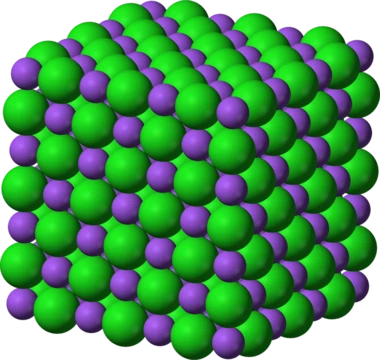
**Crystal structure** The composition FeCr2O4 has iron in the +2 oxidation state and chromium in the +3 state. The mineral’s structure is platy, with breakage along weak planes. In thin sections, chromite appears as disseminated, euhedral to subhedral crystals. It contains magnesium, ferrous iron, aluminium, and trace titanium. Because chromite belongs to the spinel group, it forms complete solid solution series with other group members, including chenmingite (FeCr2O4), xieite (FeCr2O4), magnesiochromite (MgCr2O4), and magnetite (Fe²⁺Fe³⁺₂O₄). Chenmingite and xieite are polymorphs of chromite, while magnesiochromite and magnetite are isostructural with it.
**Crystal size and morphology** Chromite appears as massive and granular crystals; octahedral crystals are very rare. Twinning follows the spinel law on the {III} plane. Grains are usually small, but some up to 3 cm have been found. These large grains crystallize from the liquid of a meteorite body under low chromium and oxygen conditions, associated with stable supersaturation.
**Reactions** Chromite helps determine rock formation conditions. It reacts with gases like CO and CO₂, reducing the chromite and forming iron and chromium alloys, as well as possible metal carbides. Chromite crystallizes early in the cooling process, making it resistant to alteration from high temperatures and pressures during metamorphism. It can pass through the metamorphic series unchanged, while less resistant minerals alter to serpentine, biotite, or garnet.
**Distribution of deposits** Chromite occurs as orthocumulate lenses in peridotite from Earth’s mantle, in layered ultramafic intrusive rocks, and in metamorphic rocks like some serpentinites. Ore deposits form as early magmatic differentiates, often associated with olivine, magnetite, serpentine, and corundum. The Bushveld Igneous Complex in South Africa has layers up to 90% chromite, forming the rare rock chromitite. The Stillwater Igneous Complex in Montana also holds significant chromite. Commercially viable deposits are limited to a few large sites. Two main types exist: stratiform deposits (in layered intrusions, providing 98% of global reserves) found in South Africa, Canada, Finland, and Madagascar; and podiform deposits found in Kazakhstan, Turkey, and Albania. Zimbabwe is the only country with notable reserves of both types.
**Stratiform deposits** These form as large sheet-like bodies in layered mafic to ultramafic igneous complexes, typically Precambrian in age and located in cratons. The intrusions likely entered continental crust containing granites or gneisses. They are tabular or funnel-shaped. Tabular intrusions (e.g., Stillwater and Bird River) occur as sills with parallel layering. Funnel-shaped intrusions (e.g., Bushveld and Great Dyke) dip toward the center, forming synclines. Chromite appears in multiple layers of chromitite, each 1 cm to 1 m thick, extending laterally up to 70 km. Chromitite makes up 50–95% of these layers.
- chemical_formula
- FeCr2O4
- mineral_group
- Spinel group
- color
- Iron-black
- luster
- Metallic
- streak
- Dark brown
- hardness
- 5.5 on Mohs scale
- crystal_system
- Isometric (spinel group)
Lore & Background
Chromite grains are commonly found in large mafic igneous intrusions such as the Bushveld in South Africa and India. It occurs as massive and granular crystals, rarely as octahedral crystals, and twinning occurs on the {111} plane as described by the spinel law. Chromite can be seen in thin sections with disseminated euhedral to subhedral crystals. The mineral can change into different minerals based on the amounts of each element, forming a complete solid solution series with magnesiochromite, magnetite, and other spinel group members. Chromite forms early in the crystallization process and is resistant to alteration by high temperatures and pressures in metamorphic series.
Reader's Guide
Chromite is the principal source of chromium, used extensively in metallurgy, electroplating, paints, tanning, and paper production. The vast Bushveld Igneous Complex of South Africa contains layers consisting of 90% chromite, forming the rare rock type chromitite. Stratiform deposits in layered intrusions provide 98% of worldwide chromite reserves, with major deposits in South Africa, Canada, Finland, and Madagascar. Podiform deposits are found in Kazakhstan, Turkey, and Albania. Environmental contamination with hexavalent chromium (Cr(VI)) is a major health concern, as Cr(VI) is a highly toxic carcinogen. When chromite ore is exposed to surface conditions, trivalent chromium (Cr(III)) can convert to Cr(VI) through dry milling or grinding. Cr(III) is an essential nutrient for lipid and glucose metabolism, while Cr(VI) is rarely found in nature and is generally produced through human activity.
Did You Know?
- Chromite can form grains up to 3 cm in size, associated with stable supersaturated conditions in meteorite bodies.
- The Bushveld Igneous Complex in South Africa has layers consisting of 90% chromite, forming the rare rock type chromitite.
- Chromite is resistant to alteration effects of high temperatures and pressures in the metamorphic series, progressing unaltered.
- Stratiform deposits provide 90-95% of worldwide chromite reserves.
Frequently Asked Questions
Who is Chromite?
Chromite is an oxide mineral in the spinel group whose composition is iron(II) oxide combined with chromium(III) oxide, giving it the formula FeCr2O4. It is the principal ore mineral from which chromium is extracted.
What is Chromite's role in the mineral world?
Chromite is mined almost exclusively to produce ferrochrome, an iron-chromium alloy that serves as the key feedstock for stainless steel manufacturing. In that sense it acts as the gateway mineral for one of industry's most important alloys.
What does Chromite look like?
It appears as an iron-black mineral with a distinctly metallic sheen. When scratched across an unglazed porcelain tile it leaves a dark brown streak.
How hard is Chromite on the Mohs scale?
Chromite registers at 5.5, placing it roughly between apatite and orthoclase feldspar in hardness. That makes it moderately hard—hard enough to scratch glass but soft enough to be scratched by a steel nail.
Why is Chromite important to industry?
It is the primary natural source of chromium, the element responsible for giving stainless steel its corrosion resistance. Without chromite deposits, large-scale production of stainless steel and many other chromium-bearing alloys would be impractical.
More in Minerals & Crystals 1-24
Spotted an error? Know more?
This is a living reference — every entry is fact-audited, and reader corrections feed straight into our audit queue. Suggest an edit · See this site's audit record